

Emphasizing the potential of food security and Thailand’s production base as a source for global food supply, accelerating the enhancement of agricultural products into value-added products, reducing price competition, and expanding new markets.
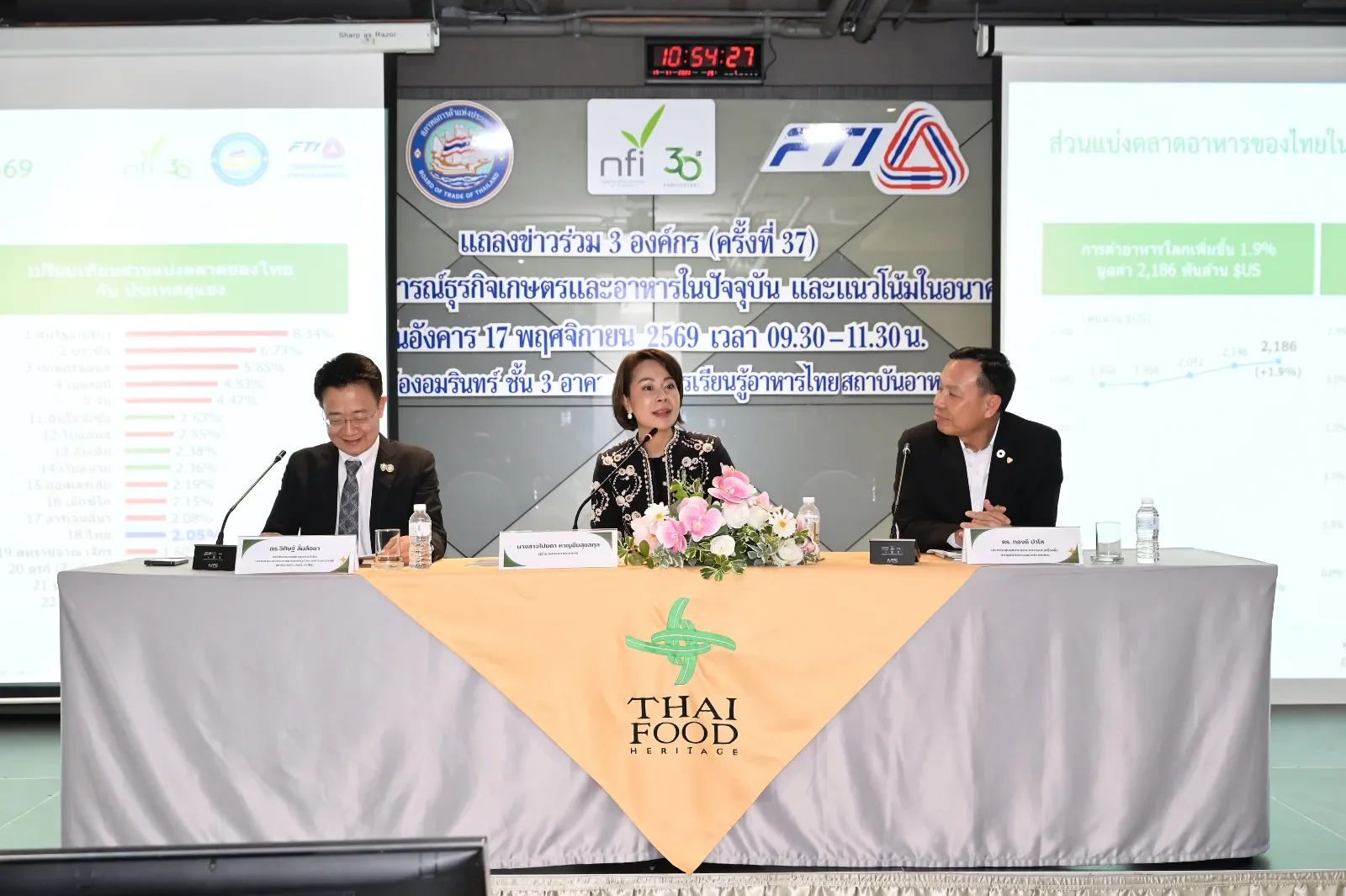
The joint press conference of the three economic organizations in the agricultural and food business for the 37th time, under the theme “Current Trends in the Agricultural and Food Business and Future Outlook,” saw the participation of representatives from the three main organizations, including Dr. Visith Limluecha, Vice Chairman of the Board, Thai Chamber of Commerce, and Chairman of the Future Food Committee; Dr. Thongdee Paso, Chairman, Food and Beverage Industry Club, Federation of Thai Industries (FTI); and Ms. Paiyada Hanchaichuk, Director of the Institute of Food, a network agency under the Ministry of Industry.
All three organizations jointly reflected on the situation of the Thai agricultural and food business, noting that in the first nine months of 2026, the Thai food industry continued to face pressures from weak domestic purchasing power, sluggish exports, and increased competition in the global market. Despite a continuous growth trend in investment in the agricultural and food processing industry, reflecting confidence in the industry’s potential in the long term, the outlook for 2027 is expected to show a rebound in Thai food exports, with significant opportunities stemming from global food demand, food security, and the enhancement of agricultural and food products to higher value-added products.
Overall, during the first nine months of 2026, the domestic and export markets faced pressures. Ms. Paiyada Hanchaichuk, Director of the Institute of Food, indicated that in the first nine months of 2026, the Thai food industry contracted by 1.5% due to rising energy prices and transportation costs, which led to increased food prices while domestic purchasing power remained weak. The value of food exports amounted to 1,140.1 billion baht, a decline of 3.7%. It is expected that the total for the year will be valued at 1.47 trillion baht, down 2.7% from the global economic slowdown, international conflicts, weak purchasing power, high production costs, and competition from rival countries, especially Vietnam, India, and China.
However, investment in agriculture and food processing continues to expand well, with applications for investment promotion amounting to 80.19 billion baht, an increase of 58.7%, ranking third after digital and electronics, and electrical appliances, reflecting confidence in Thailand’s potential as a production base for agricultural and food products, which will support industry development and technology transfer in the long term.
When considering 15 main food export product groups, only five groups showed growth: food ingredients and flavoring agents increased by 23.8%, fresh fruits and vegetables by 12.3%, pet food by 9.6%, ready-to-eat food by 5.0%, and sauces and seasoning by 0.4%. The other ten groups contracted, with cassava down by 29.9% due to raw material limitations, sugar down by 21.7%, rice down by 15.2% due to Indonesia’s import suspension measures, and beverages down by 10.4% due to weakened purchasing power and conflicts in the ASEAN market. Meanwhile, future food exports overall decreased by 7.1%, but the medical food segment still grew significantly by 43.8%, reflecting opportunities for specialized foods that address nutrition and health needs.
In terms of export markets, four markets saw growth: Oceania by 10.2%, the European Union by 7.0%, ASEAN’s five countries by 4.8%, and the United Kingdom by 2.3%, supported by the demand for food and concerns about food security from trading partners. Conversely, another eight markets contracted, with the Middle East down by 26.6%, Muslim countries by 6.9% due to conflicts and uncertainties in the region, and CLMV by 23.4% due to economic conditions and weakened purchasing power. For China, exports decreased by 2.5% due to a slowing economy; however, it remains Thailand’s number one food export market, accounting for 24.6% share.
The market share and ranking of Thai food exporters have decreased, reflecting increased competition. Ms. Paiyada also noted that the global food trade value in 2026 is expected to be 2.186 trillion US dollars, an increase of 1.9% from the previous year, but Thailand’s market share has declined from 2.14% to 2.05%, reflecting pressure from increasing competition, particularly from Vietnam, which has lower production costs and is well-equipped with raw materials. China benefits from productivity and economies of scale. China, Indonesia, and Vietnam have market shares of 4.47%, 2.63%, and 2.36%, respectively, and have gained market share, while India and Malaysia saw their shares decrease to 2.38% and 1.48%.
Thailand’s ranking among global food exporters fell from 15th to 18th, with the top five being the United States, Brazil, the Netherlands, Germany, and China. Australia moved from 17th to 15th, and Argentina from 18th to 17th, while Vietnam remained at 14th. Australia and Argentina are not direct competitors as they have distinct products compared to Thailand, such as beef, dairy products, wheat, soybean oil, and corn, while Vietnam is a significant competitor with a product structure similar to Thailand’s, including rice, seafood, cassava, canned tuna, and durian, particularly in cassava, where Vietnam has had a higher market share in China compared to Thailand over the past 1-2 years.
This situation reflects that Thailand cannot rely solely on the advantage of resources and the export of agricultural or raw food products, but must accelerate increases in productivity, develop innovations, enhance processing, and create product differentiation to increase value and reduce price competition.
Exports of Thai food are expected to recover in 2027, growing by 7.5%, reaching 1.58 trillion baht. The Director of the Institute of Food further stated that in 2027, Thai food exports are expected to value 1.58 trillion baht, expanding by 7.5%, as Thailand still has the capability to support increased orders, with a production capacity utilization rate of approximately 58% and an annual food trade surplus of about 800 billion baht, ranking sixth in the world. This, coupled with the global food demand and concerns over food security, as well as confidence in the safety standards of Thai food.
When classified by product groups, six groups are expected to grow by more than 7.5%, including flavoring agents, granulated sugar, ready-to-eat food, cassava, pet food, and rice. Meanwhile, another eight groups are expected to grow by 0-7.5%, including sauces and seasonings, coconuts, beverages, chicken, pineapples, palm oil, tuna, and fresh fruits and vegetables. Shrimp is the only group expected to shrink by 1.5% due to high costs, unpredictable weather, and competition from Ecuador and India.
Nonetheless, the industry still faces risks from disasters and climate change, geopolitical conflicts, and uncertainties in transportation routes, which affect supply chains and the costs of raw materials, energy, fertilizers, packaging, and transportation, as well as export restrictions from producing countries. At the same time, the slowing global economy and food inflation continue to pressure purchasing power, given that agricultural and primary processed foods account for as much as 60% of Thai food exports, leading to high price competition. Furthermore, operators must contend with fluctuations in orders, transportation, delivery, and tightening payment conditions, thus requiring comprehensive management of raw materials, costs, liquidity, and trade risks.
Emphasizing the potential for food security and elevating Thailand to a global food production and supply source.
All three organizations agree that although the Thai food industry faces pressures from the global economy and intensified competition, Thailand still has advantages from its diverse agricultural production base, including crops, livestock, and fisheries, which are fundamental to food security and being the kitchen of the world. Currently, Thailand has eight major agricultural products: shrimp, durian, pineapple, longan, cassava, rice, coconut, and palm oil, with a combined market value of 500 billion baht, which has the potential to expand from raw material production to processing with technology and innovation to develop high-value products and enhance business opportunities for domestic operators.
Dr. Thongdee Paso, Chairman, Food and Beverage Industry Club, Federation of Thai Industries (FTI), stated that the Thai food industry relies heavily on agricultural raw materials by up to 90%, raising concerns over the super El Niño situation in the next 2-3 years, which may lead to droughts and affect agricultural production. He suggested that the government expedite water management and develop disease-resistant crop varieties while Thailand should swift FTA negotiations with various countries to leverage FTA benefits to enhance competitiveness and expand export markets and provide support for certain agricultural products that cannot compete, to ensure raw material security and drive sustainable growth of the Thai food industry.
Dr. Visith Limluecha, Vice Chairman of the Board, Thai Chamber of Commerce and the Federation of Thai Chambers of Commerce, and Chairman of the Future Food Committee, stated that the direction of the Thai food industry will begin to see increased new investments, especially in enhancing productivity with modern production technology and innovation, in line with the BOI’s investment promotion applications in the agriculture and food processing sectors amounting to 80.19 billion baht, an increase of over 50%, reflecting confidence in the potential of the Thai food industry. Moreover, Thailand should accelerate the development of functional ingredients and the technology for extracting key substances from agricultural raw materials to increase domestic product value, reduce dependence on imports of high-value extracts, and transition from low-priced raw material exports to high-value-added product manufacturing, which is a future food category with growth potential and will enhance the competitiveness of the Thai food industry in the long term.
For 2027, all three organizations propose linking the agricultural base with processing capabilities to develop Thailand as a reliable food production and supply hub by planning production in accordance with industry demand, improving the quality of raw materials and traceability systems, while utilizing factory production capacity to accommodate contract manufacturing, co-developing formulas, and producing under the brands of foreign partners, alongside upgrading technology, labor skills, and standards. Additionally, products should be prepared for both commercial markets and emergency reserve markets, focusing on health, nutrition, taste, shelf life, and convenience based on purchasing power and the requirements of each market.
They recommend expediting adaptation and enhancing competitiveness of the Thai food industry in 2027.
The three organizations propose that both the government and the private sector urgently adapt in four critical areas: ensuring stability in raw materials and supply chains, with the government supporting research on climate-resilient crop varieties, developing water systems, and monitoring plant diseases, while the private sector plans production and procurement together with farmers, diversifying sourcing, and preparing backup raw materials.
On technology, labor, and standards, the government should support funding, skill development, and standard testing services, while the private sector applies AI, automation, and sensors to enhance food safety and efficiency, reduce water and energy usage, and strengthen cybersecurity and business continuity plans. Regarding cost management and logistics, the government should monitor food costs and reserves, develop transportation systems and cold chain logistics, while the private sector diversifies transport providers and routes, manages cash flows and inventories, and prepares necessary production factors.
Moreover, there should be a swift utilization of Free Trade Agreements (FTAs) to expand markets and create added value, with the government facilitating rights utilization, pushing for trade negotiations, and opening new markets while supporting research and development. The private sector should correctly utilize FTA rights to diversify markets and distribution channels, and also develop health foods, convenience foods, and products with longer shelf lives to increase value and enhance competitiveness of the Thai food industry in the long term.
———————————-
News Source : https://www.google.com/url?rct=j&sa=t&url=https://fti.or.th/news/1788-3-economic-organizations-indicate-thai-food-industry-facing&ct=ga&cd=CAIyHGY3N2RkMGYwMjUwYTJhNjg6Y29tOnRoOlRIOlI&usg=AOvVaw3pSc0gVZeig7Ip7jBVUq_h